Vancouver's Most Purposeful Cooking: Andrea Carlson and Nutcha Phanthoupheng
I grew up on the west coast, and I've spent the last eighteen years in Milano. My uncle's Italian restaurant on Commercial Drive is what started me down the food path in the first place, and it's also what pulled me toward Il Bel Paese. Family keeps bringing me back to Vancouver, often. But trip after trip, the thing I kept failing to find was a chef here building something entirely their own, with the kind of ambition you simply expect in Lima, Copenhagen or Milano. Two women have changed that. One cooks in a narrow room on Main Street, from a garden she plants herself. The other runs a glass-walled dining room on the Steveston waterfront, rebuilding a royal cuisine most Canadians have never heard of. Since I'm better known for writing about what people drink, I judged both by the bar as much as the kitchen.
Andrea Carlson: the long apprenticeship on the coast
Carlson took the classic Pacific Northwest route. Dubrulle Culinary School first, then the kitchens that were quietly building a regional identity for BC cooking long before anyone thought to put it in a press release: Sooke Harbour House, C Restaurant, Raincity Grill. In 2007 she became executive chef at Bishop’s, stayed four years, and won Vancouver Magazine’s Best Regional Restaurant award twice.
Then she started building her own rooms. Harvest Community Foods opened in 2012, Burdock & Co in May 2013 in Mount Pleasant, and Bar Gobo, a vinyl-only hi-fi wine bar in Chinatown, in 2020. All three source from the same trusted circle of local farmers and producers.
In 2022 Burdock & Co became the first Canadian restaurant owned and operated by a woman chef to take a Michelin star, and has held it every year since. Carlson is still the only female chef in BC leading a starred restaurant, a sentence I find absurd to be typing in 2026.
Farm-to-table has lost most of its meaning through overuse. Burdock is one of the few places that still deserves it. The Moon Menu Series runs six seasonal tasting menus a year, each keyed to a lunar phase and a single botanical theme. The current one, seven courses, closes on October 12. It is called Submerging Stones under a Sturgeon Moon, after a ritual Carlson describes in her cookbook: on the night of the full moon you write down your worries, tie the paper to a stone, sink it, and the sturgeon carries them off.
The opening dish is also Carlson’s favourite, and it tells you how the kitchen thinks. Rosehip-glazed scallops sit on a gelée of tomato dashi made from salt-cured scallop mantles, finished with a gold-dusted tuile built from the skins and seeds the dashi leaves behind. Nothing is wasted, and nothing is decorative for its own sake. The corn course is a risotto with no rice in it: hard-seared kernels in a purée of stock drawn off the cobs, cut with lacto-fermented crab apple broth and Sugar Rush Peach chilli.
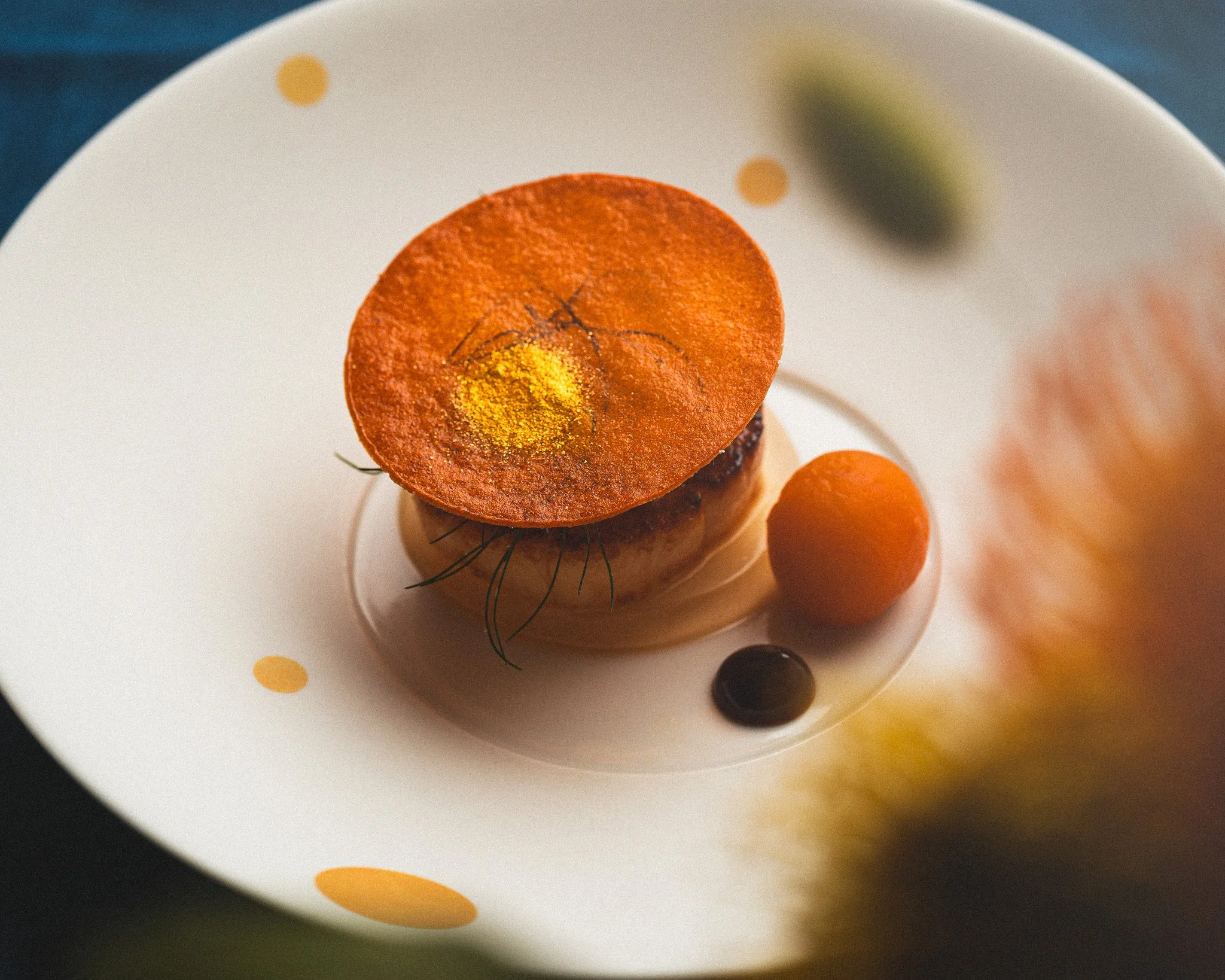
Rosehip Glazed Scallop at Burdock & Co
If you are short on time, skip the reservation and pull up a stool. The walk-in-only bar menu turns over every two months, and right now it holds Stoney Paradise tomatoes, padrón peppers with garlic crunch and almond parmesan, and a fig-sap ricotta made to order in a fig leaf from Carlson’s garden.
The room has been tightening up on the floor as well. Mya Brown arrived as general manager from Le Crocodile by way of Botanist, and the wine list has been Maisie Ryan’s since 2025, after Bacaro, Chupito and Dachi, where she still works one day a week. Her pairings lean natural, carry a lot of sake, and land more often on playful than on textbook.
The cocktails are a handful of house drinks at a time, drawn from the same pantry the kitchen works out of, so the fermented and preserved things in the food turn up in the glass as well. More interesting: the bar menu gives its non-alcoholic cocktails equal billing with the wine, rather than parking them at the bottom of the page for the designated driver.
Nutcha Phanthoupheng: the second career
Thai and Lao cooking is personal territory for me. Years of it in Asian-focused Vancouver and Toronto, then Bangkok, which has become my favourite food city in Southeast Asia. So I came to Nutcha Phanthoupheng’s story already invested, and it turned out to be nothing like the one I expected. She was born in the Isaan countryside of northeastern Thailand, on a family farm where they grew rice and vegetables, raised buffalo, pigs and chickens, and foraged for mushrooms, wild honey, and insects. She took her BSc at Khon Kaen, became a registered nurse, and worked as a cancer researcher at Bangkok’s Princess Chulabhorn Hospital, selected for the role by the Princess herself. Thirteen years in healthcare went by before she turned to cooking in 2019.
Most chef origin stories are ornament. But Chef Nutcha's is the argument her cooking makes. In an essay published in January, she writes about watching patients on radiation and chemotherapy lose their appetite, their sense of taste and their strength, and about the ones who went home instead, ate what they wanted, and passed away with their families around them. Hospitals, she concluded, had the treatment right and the eating wrong. "Appetite matters. Happiness matters," she writes. That is what sent her into a kitchen.
She moved to Canada, then went back to Thailand to train under Chumpol Jangprai, the two-Michelin-starred chef behind R-Haan, and Vichit Mukura, who cooked for the Thai royal family. She added a Thai Cuisine diploma from The Blue Elephant, certification from the Mandarin Oriental Bangkok Cooking School, and a carving certificate from Bussaracum. Baan Lao opened in Steveston in February 2021, mid-pandemic.
Royal Thai cuisine is the most rule-bound cooking you will meet in a Canadian dining room, and if what you love about Thai food is the blunt force of a night market som tam, you will need to recalibrate at the door. Bones, pits and stones come out by a technique called pawk riew. Flavours are balanced away from extremes, heat included. Vegetables going into a sauce must be unblemished and uniform whether or not anyone sees them, and the sous chef spends ten minutes carving each carrot gift box for one element of the amuse bouche. There is no walk-in freezer, so shopping happens weekly and often daily, from farms within 90 km, and the rice comes off 15 acres in Khon Kaen that have been in her family for 80 years.
Nutcha describes innovation as meaningful only once you understand the roots, which is the most Italian thing I have ever heard a Thai chef say. Much like Diego Rossi and the quinto quarto at Trippa in Milano, she puts humble ingredients at the centre of the room. Water buffalo is peasant food in Thailand; she gives it royal technique, and says her own former teachers have since followed. She also created the first Thai afternoon tea, twelve dishes with five tea pairings, which has since migrated back to Thailand. Her latest tasting menu, From Thailand With Love, runs eighteen items across the four corners of the kingdom.
Two dishes stand out for me. The massaman is braised water buffalo shank, the peasant cut given the court treatment: meat that gives way under the side of a spoon, in a sauce that holds sweetness, salt and warm spice in balance, with basil rice, kabocha and a potato purée alongside. The closer is her pad thai, a surprising and disarming way to end an eighteen-course royal menu. The tamarind brightness and the textural contrast are exactly where they should be, under an egg net hand-woven strand by strand over four hours.
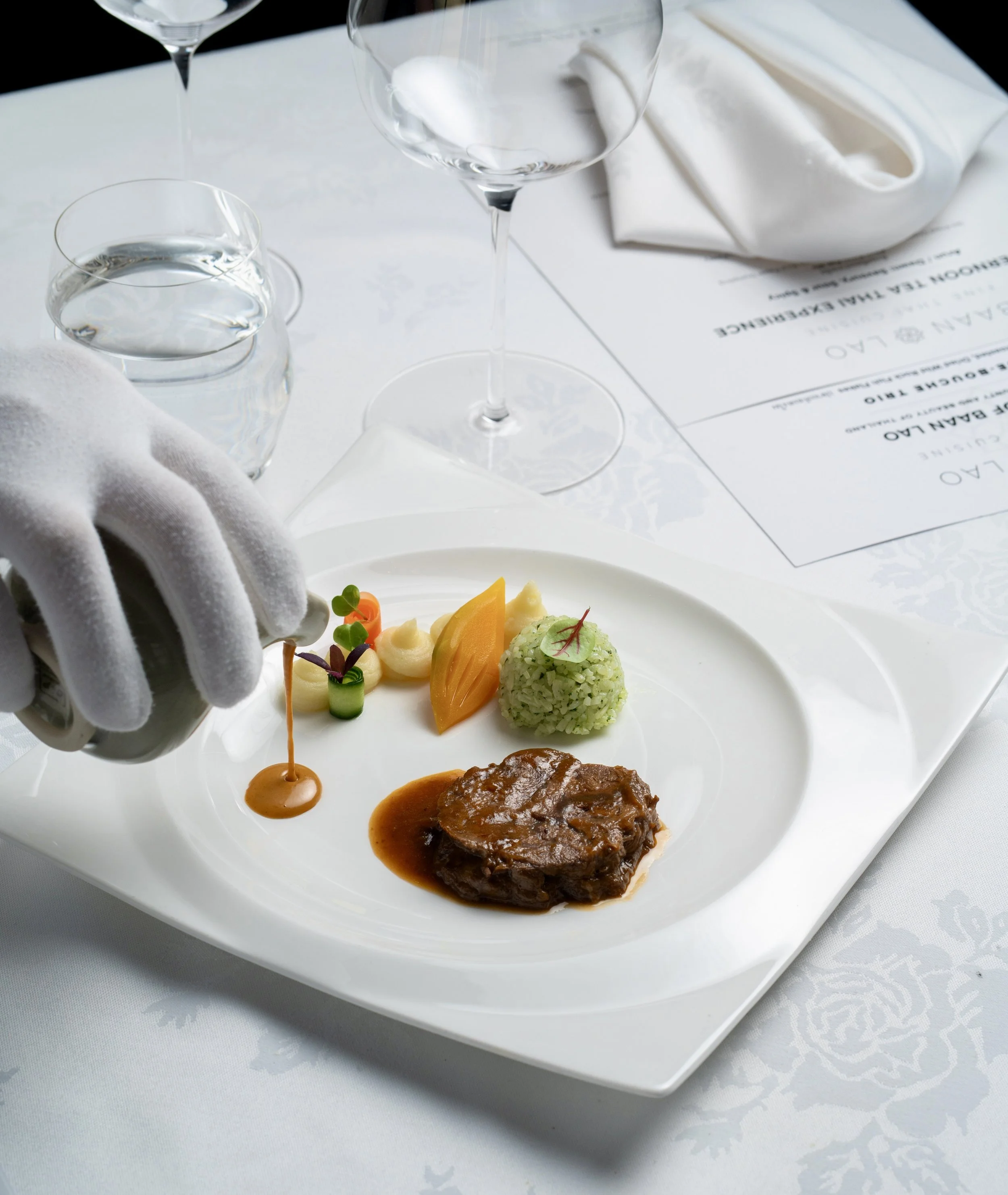
Water Buffalo Shank and Massaman Curry at Baan Lao
Baan Lao pours seven parallel flights: wine, cocktail, mocktail, sake, gong fu cha with caffeine, a caffeine-free tea flight, and a hybrid that moves between them. Each one is built by a different specialist. I would order the cocktails, and the reason is the name behind them. The beverage consultant here is Kaitlyn Stewart, the first Canadian to win World Class Global Bartender of the Year, in Mexico City in 2017. Her book Three Cheers gives every classic three treatments: the original, a zero-proof build and a riff. That should tell you the mocktail flight is no consolation prize.
The glass follows the same logic as the plate. Aromatics track what Chef Nutcha is already using: tamarind, pandan, lemongrass, kaffir lime, wild pepper leaf, palm sugar. Heat gets dialled back so nothing in the drink fights the food.
What they share
As personalities and as cooks they have very little in common, which is what makes the overlap worth noticing. Both build menus backwards from growers rather than forwards from a concept. Both refuse the received hierarchy of ingredients: Carlson makes a raw turnip the most interesting thing on the table, Nutcha gives buffalo the treatment reserved for court cuisine. Both waste nothing. Both had to build their own rooms in order to cook the way they wanted.
They converge on the drinks too. Both hand the beverage programme to a named specialist rather than to whoever the floor manager can spare. Both design the non-alcoholic side rather than buy it in. And both use the glass as a second voice for the argument the plate is already making.
Burdock & Co is at 2702 Main Street in Vancouver. Baan Lao is at 4100 Bayview Street in Steveston, half an hour south. Do both, ideally in the same week. I have spent eighteen years explaining Canadian food to Italians who assume it stops at maple syrup, and these are the two tables I would proudly sit them down at.